 Канал на RUTUBE:

The end of the last world war.
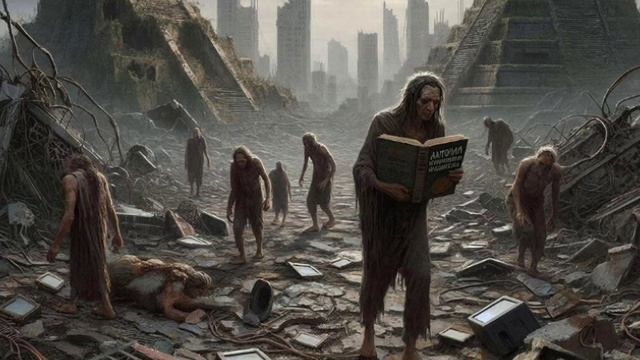
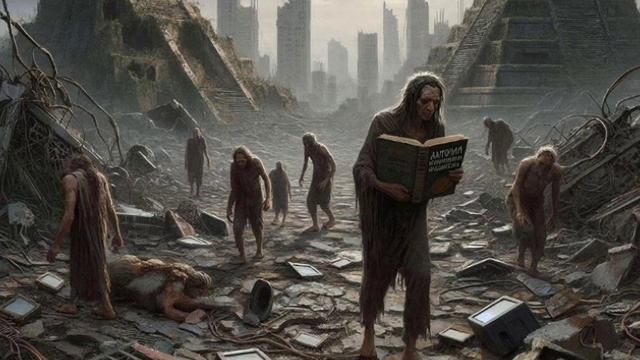
The end of civilization.
Duration and timelines.
How we got here: the anatomy of civilizational collapse
A view from the digital ruins: on the nature of decline
Human history is not a straight line of triumphant ascent but a graveyard of numerous civilizations.
In 390 AD the Roman Empire covered 4.4 million square kilometers five years later its territory had halved and by 476 AD it had vanished from the world map.
The Maya the Anasazi Akkad the Hittites they all traveled the path from flourishing to ruins.
Historian Arnold Toynbee having studied 28 civilizations in his 12-volume work delivered a merciless verdict: great civilizations do not perish from an external blow they complete themselves from within.
The modern internet discourse around civilizational collapse revolves around two polar positions.
The first is academic: historians archaeologists and specialists in cliodynamics seek repeating patterns comparing the trajectories of ancient empires with the state of the global world.
The second is eschatological amplified by social platform algorithms: every new war climate anomaly or political crisis generates a wave of content about the end times.
The truth as usual is more complex than either extreme.
The Bronze Age Collapse circa 1177 BC is a textbook example of systemic collapse.
Within a single generation the Minoan kingdom Mycenae the Hittite Empire Troy and Ugarit fell.
Writing disappeared archives were burned palaces destroyed trade links between continents severed.
A Dark Age lasting several centuries ensued.
The Egypt of Ramses III repelled the invasion of the Sea Peoples but the victory bled the country so dry that within decades it too fell into decline.
This scenario the sudden implosion of a complex system after centuries of prosperity resonates alarmingly with the present day.
Universal markers of an impending finale.
An analysis of search results allows us to identify several key factors that modern researchers consider indicators of civilizational decline.
Symptomatically all of them are actively discussed in relation to the current moment.
Climate instability as a trigger.
The Anasazi Tiwanaku the Akkadian Empire Rome all faced sudden climatic shifts most often droughts which undermined their agricultural base.
Today global temperature CO₂ concentration and the ecological footprint indicator are growing exponentially.
The difference is that previously climate collapse was regional now it is global.
Complexity devouring itself.
Joseph Tainter formulated a paradox: society becomes more complex to solve problems but each new degree of complexity yields diminishing returns.
A moment arrives when maintaining the bureaucratic apparatus infrastructure and social institutions becomes energetically unprofitable.
A modern indicator is EROI energy return on investment: fossil fuels provided a ratio of energy expended to gained of 1:100 renewable sources 1:10 or worse.
The Roman Empire collapsed with the fall in the EROI of wheat and alfalfa modern civilization faces an energy cliff.
Inequality eroding the social fabric.
Cliodynamics has revealed a stable correlation: population growth cheapening of labor concentration of wealth in the hands of the elite loss of social cohesion political instability.
In 1980 the richest 1 owned 25-30 of the worlds wealth by 2016 it was 40.
Accounting for offshore holdings the real figure is higher.
Institutional sclerosis.
Mancur Olson in his book The Rise and Decline of Nations showed that stable societies accumulate special interest groups that optimize distribution in their favor blocking innovation and adaptability.
Germany and Japan grew faster than Britain and the US after World War II precisely because the war destroyed their ossified institutions.
The domino effect: why globalization has made us more vulnerable.
Modern civilization differs fundamentally from its predecessors in one critical aspect interconnectedness.
When the cities of the Eastern Mediterranean collapsed in 1177 BC China and the Indus Valley Civilization did not notice.
Today a collapse in one part of the planet is instantly transmitted through global supply chains financial systems and information networks.
BBC Future formulates the metaphor of a ladder without rungs: as we climb the technological ladder we kick out the lower rungs.
A fall from the height of an agrarian society meant a return to hunting and gathering traumatic but not fatal for the species.
A fall from the height of the nuclear era means either the disappearance of humanity or a fall back into the Stone Age without the possibility of recovery since accessible fossil fuel deposits are already exhausted.
Particular concern is raised by the phenomenon historians call the domino effect: states collapse not in isolation but in whole clusters pushing one another over.
T
Источник: rutube.ru



![ВЕСЕННИЙ МЕДОСМОТР #2 [SKZ CODE] Ep.96 | ИГРА В ПРАВДУ | Spring Check-up Day | НА РУССКОМ](https://pic.rtbcdn.ru/video/2026-04-17/83/59/8359b9ae3d74515e62814dc372d89874.jpg)